Your SaaS company publishes regularly on LinkedIn and X.
The founder shares opinions. The marketing team posts educational content. Employees engage with company updates. Some posts receive strong reach, comments, and reposts.
But there is one question most teams cannot answer:
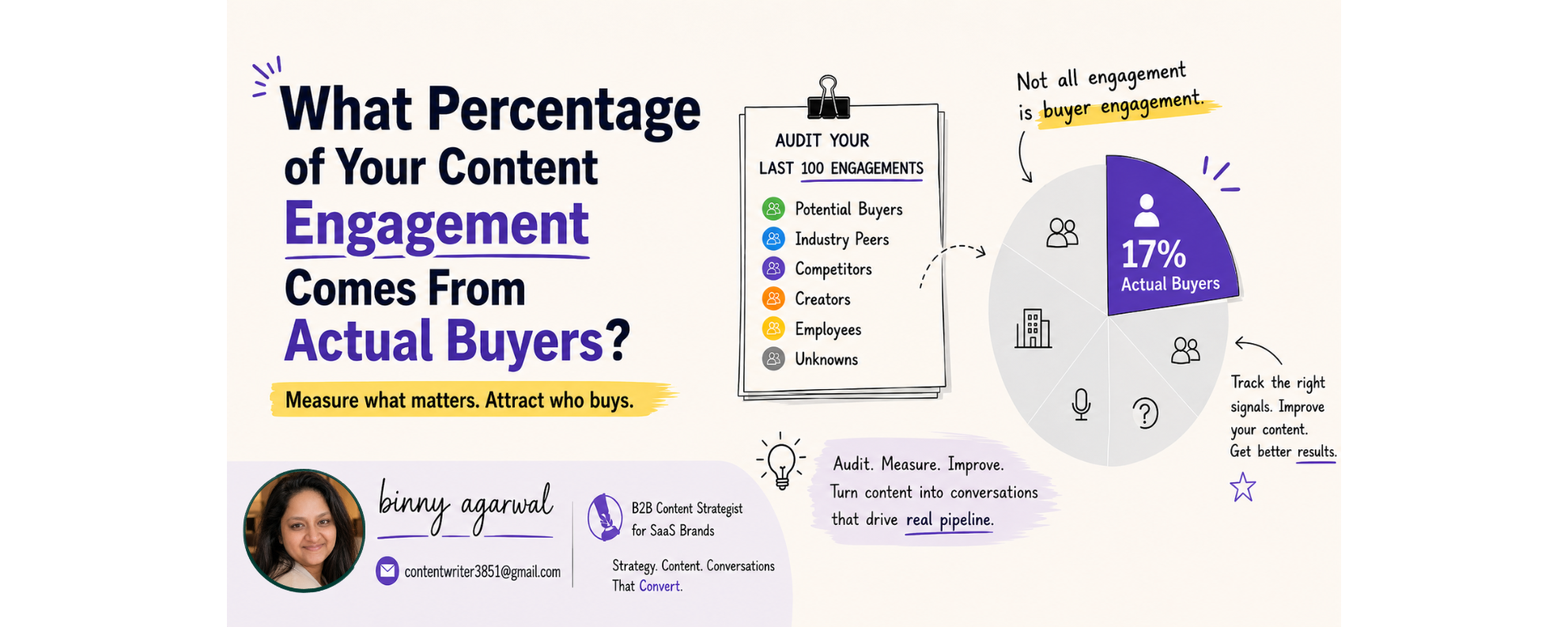
What percentage of that engagement comes from people who could actually buy the product?
A post may receive 100 SaaS content engagements and still create no qualified sales conversations. Another post may receive only 20 engagements but attract three decision-makers, start two direct messages, and lead to a sales call.
The second post is more valuable, even though its visible engagement is lower.
This is the problem many SaaS teams face. They are publishing content, but they do not have a clear system for connecting that content with ideal buyers, conversations, leads, calls, opportunities, and pipeline.
Social media can generate leads, but posting is not enough
Social media is no longer only a brand-awareness channel.
HubSpot’s 2026 Sales Trends research found that 42% of sales teams said social media produced their best cold-outreach response rate. Another 35% said social media was their highest-quality lead source.
That sounds promising for SaaS teams using LinkedIn and X.
However, being active on social media does not automatically create leads. Your content must attract the right people, speak about problems they care about, and give interested readers a reason to continue the conversation.
Without that structure, teams often confuse content activity with content performance.
They count:
- Impressions
- Likes
- Comments
- Followers
- Reposts
- Profile views
These numbers can help you understand reach. But they do not tell you whether your content is reaching potential buyers.
Start by auditing your last 100 engagements
A simple buyer-engagement audit can give you a much clearer picture of your current audience.
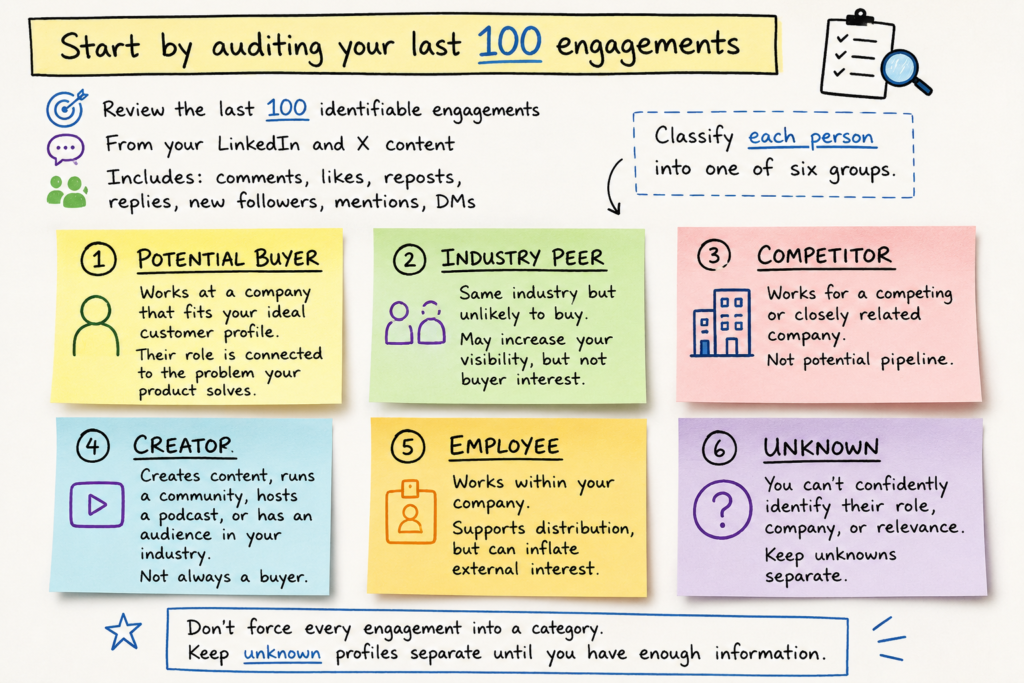
Review the last 100 identifiable engagements received across your LinkedIn and X content. These may include comments, relevant likes, reposts, replies, new followers, mentions, and direct messages.
Classify each person into one of six groups.
1. Potential buyer
This person works at a company that fits your ideal customer profile.
Their role is connected to the problem your product solves. They may be the final decision-maker, a user, a department leader, a budget holder, or someone who influences the buying process.
2. Industry peer
This person works in the same industry but is unlikely to buy from you.
They may be another marketer, founder, consultant, salesperson, or SaaS professional. Their engagement may increase your visibility, but it does not automatically represent buyer interest.
3. Competitor
This person works for a competing or closely related company.
Competitor engagement may indicate that your ideas are gaining industry attention. However, it should not be counted as potential pipeline.
4. Creator
This person primarily creates content, runs a community, hosts a podcast, or has an audience in your industry.
Creators can help your content travel further. They may also create referral or partnership opportunities, but they are not always buyers.
5. Employee
This engagement comes from someone working within your company.
Employee engagement can support distribution. But if most of a post’s initial engagement comes from employees, the visible numbers may create an inflated picture of external interest.
6. Unknown
You cannot confidently identify the person’s role, company, or relevance.
Do not force every engagement into a category. Keep unknown profiles separate until you have enough information.
Calculate your buyer-fit engagement rate
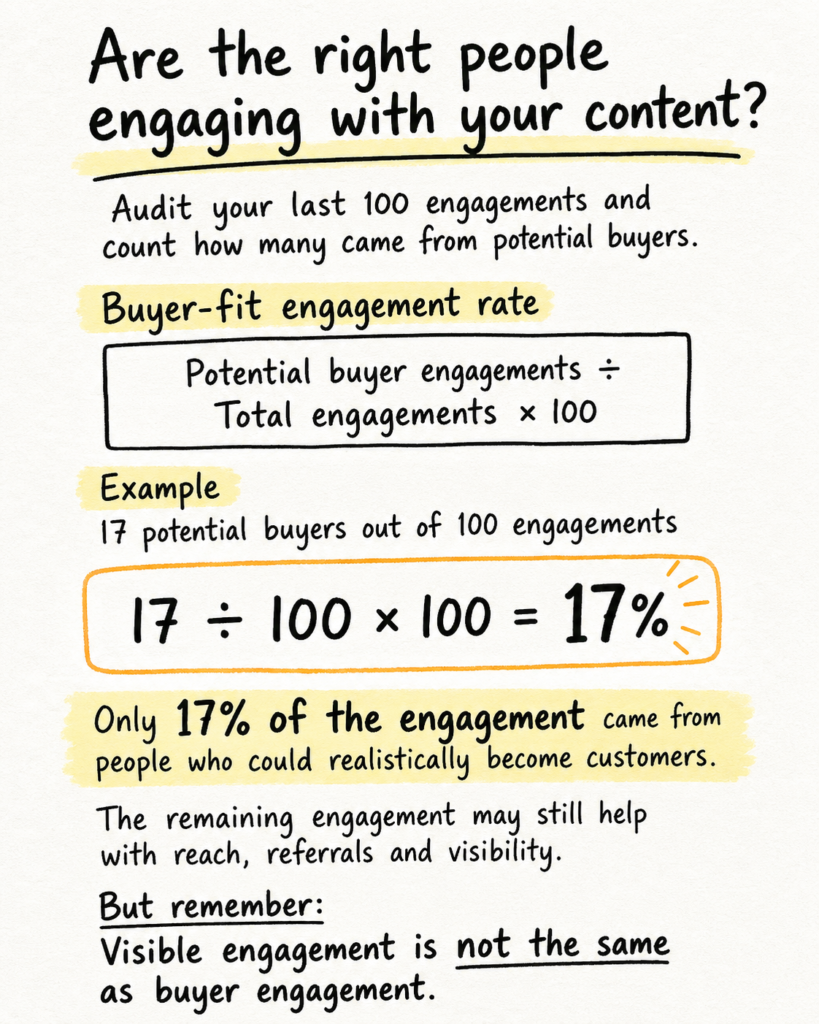
Once you have classified the 100 engagements, calculate the percentage that came from potential buyers.
Use this formula:
Buyer-fit engagement rate = Potential buyer engagements ÷ Total engagements audited × 100
Suppose your audit produces the following result:
- 17 potential buyers
- 28 industry peers
- 8 competitors
- 16 creators
- 21 employees
- 10 unknown profiles
Your buyer-fit engagement rate would be:
17 ÷ 100 × 100 = 17%
This means only 17% of the audited engagement came from people who may realistically become customers.
That does not automatically mean the other 83% was worthless. Industry peers may refer you. Creators may increase distribution. Employees may help the post reach more people.
But the result tells you that your visible engagement is not the same as buyer engagement.
Do not expect every potential buyer to purchase immediately
A potential buyer does not need to be ready for a demo today.
LinkedIn’s B2B Institute explains that around 95% of potential B2B buyers are out of the market at a given time. They may fit your target audience but have no immediate reason to purchase. Their existing contract may still be active, the problem may not be urgent, or the budget may not be available yet.
Your content therefore has two jobs.
It should create conversations with buyers who are already considering a solution. It should also help relevant future buyers remember your company when their situation changes.
This is why you should not judge every post only by the number of immediate demo requests it creates.
However, the people consuming the content should still have a reasonable connection to your market. Reaching future buyers is valuable. Reaching a large audience that will never need your product is much less useful.
The buyer may not be the person you expect
B2B buying decisions are rarely controlled by one person.
The main user may like your product, but legal, finance, procurement, compliance, or operations may also influence the final decision. Edelman and LinkedIn describe these internal stakeholders as “hidden buyers.”
Their 2025 research found that 79% of hidden buyers were more likely to advocate for a vendor during an RFP process when that vendor consistently published high-quality thought leadership.
This means your definition of a potential buyer should not be too narrow.
For example, a cybersecurity SaaS company should not create content only for security leaders. Its buying group may also include IT, compliance, finance, procurement, and company leadership.
The purpose of your audit is not to identify only the person who signs the contract. It is to identify people who may influence whether the contract is signed.
Why SaaS teams attract the wrong engagement
Most teams do not deliberately create content for the wrong audience.
The problem usually begins before the post is written.
They start with questions such as:
“What should we post this week?”
“What format is trending?”
“What did our competitor publish?”
“What topic will get more comments?”
These questions focus on content production. They do not focus on the buyer.
Without an exact buyer definition, the team writes for a broad SaaS or business audience. Without clear positioning, it talks about too many unrelated problems. Without defined content pillars, topics are selected based on convenience rather than commercial relevance.
The result is content that may be useful, interesting, and well-written but is not connected to a clear buying audience.
Use the SaaS Social-to-Lead Workbook to fix the gap
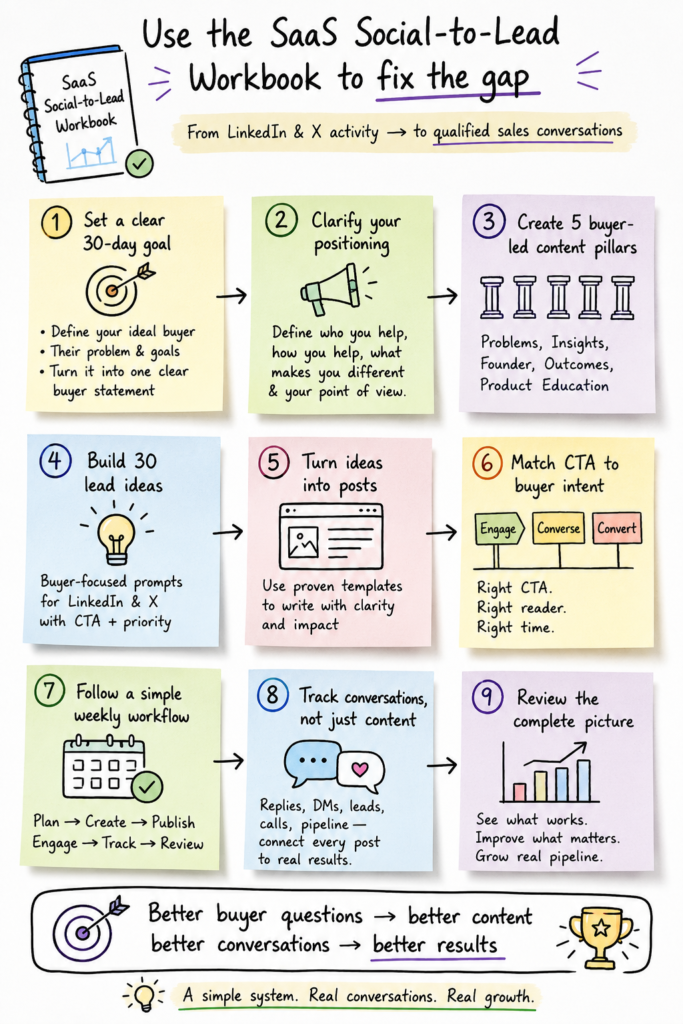
I created the SaaS Social-to-Lead Workbook to help teams connect their LinkedIn and X activity with qualified sales conversations.
It is not simply a list of post ideas.
It takes you through the complete process of defining your buyer, clarifying your positioning, planning content, publishing it, capturing buyer signals, and measuring the commercial results.
Here is how the system works.
Step 1: Set a clear 30-day business goal
The workbook begins with the Audience & Goal section.
Instead of starting with the number of posts you want to publish, you begin with the business outcome you want the content to produce.
You define:
- Your primary business outcome
- Your measurable 30-day target
- Your ideal buyer’s role
- Their company type
- Their company stage
- Their most urgent problem
- What they have already tried
- Why the problem remains unresolved
- The result they want
- What may prevent them from buying
The workbook then helps you turn these answers into one clear ideal-buyer statement.
This gives your team a practical reference point. Before publishing an idea, you can ask whether it would attract, educate, or start a conversation with that specific buyer.
Step 2: Clarify what your SaaS company should be known for
The Positioning section helps you define the message your social presence will own.
You identify who you help, what they want to achieve, how your product helps them, what makes your approach different, and which buyer problem you want to become associated with.
The workbook also asks you to define your strongest point of view.
This matters because useful content alone is not always memorable. Buyers should gradually associate your company with a specific problem, outcome, or perspective.
When your positioning is clear, the content becomes more consistent. Different team members can create posts without making the company sound like it changes direction every week.
Step 3: Create five buyer-led content pillars
The workbook organises your ideas around five content pillars:
- Buyer problems
- Educational insights
- Founder or team perspectives
- Customer outcomes
- Product or service education
Each pillar serves a different purpose.
Buyer-problem posts show that you understand what the audience is facing. Educational posts help readers solve part of the problem. Founder posts add experience and a distinct point of view.
Customer-outcome posts provide proof. Product-education posts help buyers understand when, why, and how to use the solution.
For each pillar, the workbook asks you to define the buyer problem being addressed and the action you want the buyer to take.
This keeps the content connected to buyer needs instead of filling the calendar with unrelated topics.
Step 4: Build 30 lead-generating ideas
The Idea Bank gives you 30 prompts across the five content pillars.
These are not generic prompts such as “share a tip” or “tell a story.” They are built around questions that can uncover buyer pain, buying objections, useful lessons, customer proof, and product fit.
For example:
- What problem does your buyer underestimate?
- What is the cost of ignoring it?
- What should buyers do before selecting a solution?
- When is your product not the right fit?
- What result has a customer achieved?
- What question should a buyer ask during a sales conversation?
For every idea, you can define a LinkedIn angle, an X angle, a CTA, its current status, and its priority.
One core insight can therefore be adapted for both platforms without copying the same post word for word.
Step 5: Turn ideas into publishable posts
The workbook includes repeatable templates for:
- Problem-led posts
- Contrarian posts
- Educational posts
- Case studies
- Founder lessons
- Soft-pitch posts
Each template explains when to use it, how to structure it, how to adapt it for LinkedIn, how to adapt it for X, and which CTA may fit.
This reduces the time spent staring at an empty document.
The template does not write the final post for you. It gives your ideas a clear structure so you can move from strategy to writing faster.
Step 6: Match your CTA to buyer intent
Not every reader is ready for the same next step.
The workbook’s CTA Library separates CTAs into three levels:
Engagement CTAs encourage readers to share an opinion or experience.
Conversation CTAs invite a message, framework request, or low-pressure discussion.
Conversion CTAs encourage a strategy review, audit, call, or direct conversation about your service.
This prevents two common mistakes.
The first is publishing every post without a next step. The second is asking cold readers to book a call before they have shown meaningful interest.
Step 7: Follow a manageable weekly workflow
The workbook converts the strategy into a weekly routine.
On Monday, you review customer questions, sales conversations, and relevant industry discussions. You then select the week’s topics and identify ideas that can be adapted across LinkedIn and X.
On Tuesday, you draft the posts, add examples and evidence, select the CTAs, and check every post for relevance.
From Wednesday to Friday, you publish, respond to comments, engage with target buyers, record buyer signals, and follow up on relevant conversations.
On Friday, you review the strongest topics, update lead results, and use new buyer questions to shape the next week.
This creates a repeatable system rather than depending on last-minute inspiration.
Step 8: Track conversations, not only content
The Lead Tracker connects individual posts with business activity.
For every post, you can record:
- Platform
- Topic
- Published URL
- Relevant replies
- DMs started
- Qualified leads
- Calls booked
- Opportunities created
- Pipeline value
- Follow-up action
- Notes
This is where the system becomes commercially useful.
You are no longer asking only, “Which post received the most likes?”
You can ask:
“Which topic started the most relevant conversations?”
“Which post generated qualified leads?”
“Which CTA encouraged buyers to respond?”
“Which content contributed to a real opportunity?”
Step 9: Review the complete picture
The workbook’s dashboard automatically totals your ideas developed, posts planned, posts published, relevant replies, DM conversations, qualified leads, calls booked, opportunities, and pipeline value.
At the end of the month, the Monthly Review asks you to identify which topics attracted the right buyers, which CTAs worked, which questions appeared repeatedly, and what should change during the next 30 days.
This creates a feedback loop.
Buyer questions improve your content. Better content creates more relevant conversations. Those conversations give you new information about what buyers want, fear, misunderstand, or need before making a decision.
Your next 100 engagements should be more relevant
The purpose of social content is not to make every person who engages with you purchase immediately.
It is also not to remove creators, peers, employees, or industry professionals from your audience.
The goal is to increase the percentage of relevant people paying attention and create a clear path from that attention to a business conversation.
Start with your last 100 engagements.
Classify the people behind the numbers. Calculate your buyer-fit engagement rate. Identify which posts attracted potential buyers and which mainly attracted people outside your target market.
Then use the SaaS Social-to-Lead Workbook to improve the complete system behind your content.
Because the real question is not whether people are engaging with your posts.
It is whether the right people are engaging—and whether your team knows what to do next.
No responses yet