A few years ago, checking your brand visibility was simple. You searched your name on Google, checked your website ranking, looked at organic traffic, and maybe reviewed your backlinks or LinkedIn profile.
That was enough to know whether people could find you online.
But search behaviour is changing fast.
Today, many buyers do not start with a Google search. They ask ChatGPT for recommendations. They use Perplexity to compare companies. They look at Google AI Overviews for quick answers. They do not always want ten blue links. They want a clear answer, a shortlist, or a direct recommendation.
That made me curious.
If someone asked an AI tool about my brand, what would it say? Would it understand what I do? Would it describe my services correctly? Would it connect me with SEO content, AI visibility, and B2B content strategy? Or would it give a vague answer that sounds right but misses the real positioning?
So I ran a small AI search visibility test using my own name and service category.
The results were not completely wrong. In fact, some answers were surprisingly accurate. But they also showed how easily AI tools can simplify, blend, or slightly distort a brand’s positioning.
And that is exactly why this matters for founders, consultants, SaaS companies, agencies, and service providers.
Why I Ran This AI Search Visibility Test
Most brands still think about SEO in the old way. They want to rank for keywords, get traffic, build backlinks, and appear when someone searches their brand name. All of that still matters.
But AI search adds a new layer.
When someone asks an AI tool about your brand, they may not see your homepage first. They may see a summary created from your website, LinkedIn profile, author bios, third-party mentions, client pages, guest posts, directories, and old content.
That means your brand is not only judged by what you say about yourself. It is also judged by what the internet has understood about you.
This is where AI search visibility becomes important.
It is not only about “Did my brand appear?” It is also about “Did the AI understand my brand correctly?”
For example, a SaaS company may want to be known as an enterprise automation platform, but AI may describe it as a basic productivity tool. A consultant may want to be positioned as a strategic advisor, but AI may call them a freelancer. A founder-led company may want to be seen as a category expert, but AI may only mention old services or outdated profiles.
That gap between how you position yourself and how AI describes you can affect buyer trust.
So I wanted to see what would happen when I tested my own brand.
The Experiment Setup
This was not a large scientific study. It was a simple, real-world AI visibility check.
I tested brand-related prompts on ChatGPT to see how it described Binny Agarwal in the context of SEO content strategy, AI visibility, and B2B content writing. I made sure that I use the VPN and non logged account for this experiment.
The goal was to understand three things.
First, I wanted to know whether ChatGPT could identify the core service clearly.
Second, I wanted to see whether it connected the brand with the right industries and positioning. Third, I wanted to check whether the answer would be useful for a buyer who was trying to decide whether to work with me.
Some of the prompts included:
“What does Binny Agarwal do?”
“Is Binny Agarwal a good company for SEO and AI visibility services?”
“Binny Agarwal SEO content strategist”
I checked the answers for accuracy, clarity, positioning, source signals, and buyer usefulness.
This is important because AI-generated answers can sound confident even when they are incomplete. A brand may appear in the answer, but the description may still be too broad, too old, or not persuasive enough for a serious buyer.
What ChatGPT Got Right
The first useful finding was that ChatGPT understood the broad positioning.
When asked what Binny Agarwal does, it described the brand as a freelance SEO content strategist and B2B content writer who helps companies attract customers through search engines, AI-powered search tools, and thought-leadership content.
That answer was mostly accurate.
It connected the brand with SEO content, B2B writing, AI-powered search, and thought leadership. It also mentioned relevant industries such as SaaS, finance, healthcare, startups, and founder-led brands.
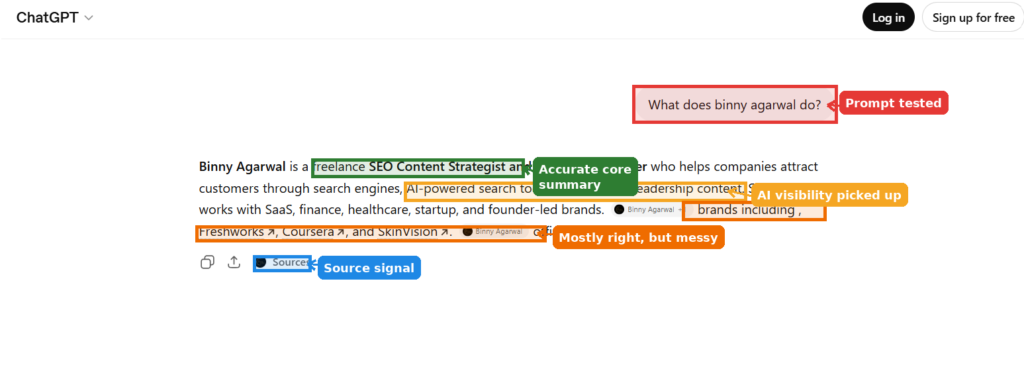
ChatGPT gave a mostly accurate summary of the brand, but the answer also showed how AI compresses positioning into a simpler version.
This was a good sign because the core message was clear enough for AI to understand. It did not confuse the brand with a completely different person or company. It also picked up the newer AI visibility positioning, which was important.
But the answer was not perfect.
Some parts felt slightly messy. For example, the sentence around brand examples and the official website did not read smoothly. That may look like a small issue, but it matters. If a potential buyer is using AI to form a first impression, even small wording issues can make the brand feel less polished than it actually is.
This is one of the first lessons from the experiment.
AI visibility is not only about being mentioned. It is about being described clearly, completely, and confidently.
The “Good Company” Prompt Was More Revealing
The second prompt was more interesting.
I asked whether Binny Agarwal was a good company for SEO and AI visibility services.
This was useful because the wording itself was imperfect. Binny Agarwal is not a large SEO company or agency. It is closer to an individual consultant or freelance strategist brand.
ChatGPT caught that distinction.
It said that Binny Agarwal appeared to be a credible freelance SEO content strategist, particularly for B2B SaaS, finance, healthcare, and founder-led businesses. But it also clarified that this was an individual consultant or freelancer rather than a large SEO agency.
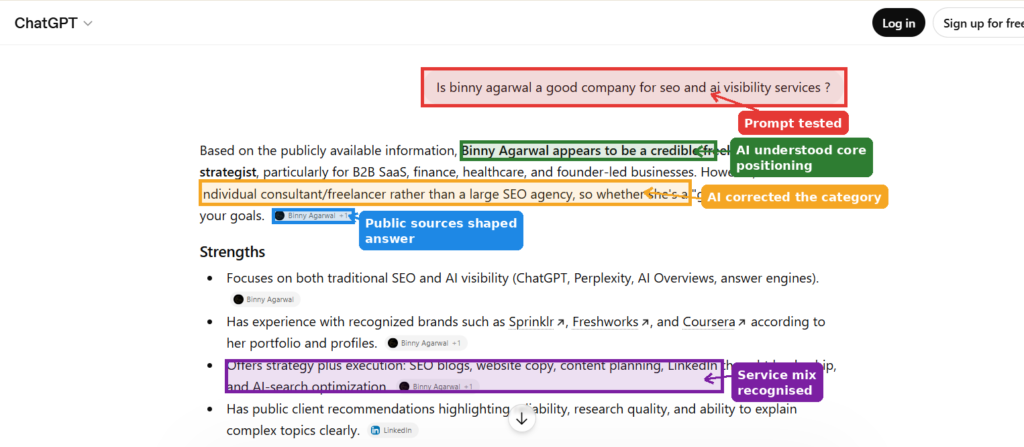
ChatGPT understood the positioning, but also clarified that the brand is an individual consultant rather than a large SEO agency.
This answer was useful because it did not blindly say yes. It explained fit.
That is important because buyers do not only want to know whether someone is “good.” They want to know whether the provider is right for their situation.
For a founder-led SaaS company, a hands-on strategist may be a strong fit. For a small team that needs SEO content, website copy, LinkedIn positioning, and AI visibility support, this kind of profile may work well.
But for a large enterprise that needs technical SEO, reporting dashboards, developer coordination, and a large execution team, a full-service SEO agency may be more suitable.
This is where AI search becomes very interesting.
AI tools are not just summarising brands. They are categorising them.
They are trying to decide whether you are a consultant, agency, freelancer, SaaS product, marketplace, media brand, or service provider. If your online presence does not make that clear, AI may make its own assumption.
And once AI frames your brand in a certain way, buyers may see you through that frame.
The Positioning Was Accurate, But Still Broad
The third prompt tested a more specific service category: “Binny Agarwal SEO content strategist.”
Here, ChatGPT connected the brand with SEO content strategy, freelance content writing, B2B SaaS, finance, healthcare, founder-led brands, AI-search visibility, AEO/GEO, website copy, LinkedIn ghostwriting, and content strategy.
That was a strong answer because it picked up both the old and new positioning.
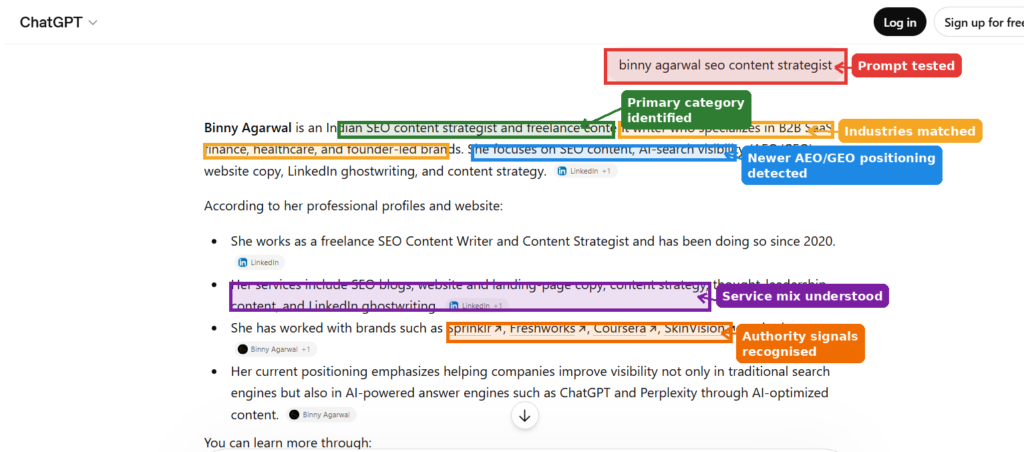
ChatGPT connected the brand with SEO content strategy, AI-search visibility, AEO/GEO, B2B SaaS, and multiple content services.
This answer showed that the brand’s public footprint had enough signals for AI to understand the service mix.
But it also showed a risk.
The answer blended several labels together. It described the brand as a content writer, SEO content strategist, freelance writer, LinkedIn ghostwriter, and AI visibility consultant.
None of these labels are wrong. In fact, they are all part of the service mix.
But from a positioning point of view, too many labels can create confusion.
A buyer looking for AI visibility strategy may not respond the same way to “freelance content writer.” A SaaS founder looking for website messaging may not immediately connect that need with “SEO blogger.” A CMO looking for a strategic content partner may want to see clearer proof of category expertise, not only a list of writing services.
This is why AI search visibility is also a positioning audit.
It shows how the internet has understood your brand. Sometimes that understanding is accurate. But it may not be sharp enough.
What Felt Weird About the Results
The strange part was not that ChatGPT got everything wrong. It did not.
The strange part was that the answers were mostly right, but not always in the most useful way.
That is a big difference.
A brand can be mentioned and still not be positioned well. An AI tool can describe your services and still miss your strongest differentiation. It can cite public sources and still create a summary that feels broader than your current positioning.
This is what many brands may struggle with in AI search.
They may think the goal is to “show up” in ChatGPT, Perplexity, or Google AI. But showing up is only the first step. The bigger goal is to show up with the right context.
For example, if a company wants to be known for AI visibility strategy, but AI keeps calling it a generic SEO agency, that is a problem. If a consultant wants to be known for B2B SaaS content strategy, but AI describes them only as a blog writer, that is also a problem.
The answer may not be false. But it may still reduce the perceived value of the brand.
That is why brands need to pay attention to how AI tools describe them, not just whether they appear.
What This Says About AI Search Visibility
This small experiment made one thing clear.
AI search visibility is not only an SEO issue. It is a brand clarity issue.
Traditional SEO focuses on pages, keywords, rankings, traffic, and backlinks. AI search visibility also depends on how clearly your brand is explained across the web.
Your website matters. But your website is not the only source.
AI tools may look at public profiles, social platforms, third-party mentions, old bios, client pages, directories, articles, guest posts, and other signals. If these sources describe your brand in different ways, AI may create a blended version.
That blended version may be technically correct, but not strategically useful.
This is why consistency matters.
If your homepage says you help B2B SaaS companies with AI visibility, your LinkedIn says you are a content writer, your author bio says you write blogs, and old guest posts call you a freelance copywriter, AI may not know which version is the most current.
It may combine all of them.
For buyers, this creates mixed signals.
And in a competitive market, mixed signals can cost you trust.
What Brands Should Check in Their Own AI Visibility Audit
If you want to test your own AI search visibility, start with a simple audit. You do not need a complex tool in the beginning. You can use ChatGPT, Perplexity, and Google AI to run basic prompts and track the answers manually.
Start with direct brand prompts.
Ask what your brand does, who it is best for, whether it is a good option for your service category, and what its strengths are. These prompts show whether AI understands your basic positioning.
Then move to category-level prompts.
Ask for the best companies, consultants, tools, or services in your niche. This helps you see whether your brand appears when the buyer does not already know your name.
You should also test problem-led prompts.
For example, instead of asking for your brand directly, ask something like, “Who can help a B2B SaaS company improve AI search visibility?” or “What companies can help with SEO content strategy for founder-led brands?”
These prompts are more realistic because buyers often search by problem, not by brand name.
When you review the answers, do not only check whether your name appears. Look at the full context.
Was your brand described correctly? Were your services clear? Did competitors appear instead of you? Were the sources relevant? Was the answer current? Did the AI understand your target audience? Did it explain why someone should consider you?
That is where the real insight comes from.
How Brands Can Improve AI Search Visibility
The goal is not to trick AI tools. That is the wrong approach.
The goal is to make your brand easier to understand, verify, and trust.
Start with your own website. Your homepage should clearly explain what you do, who you help, and why you are credible. Your service pages should not be vague. They should answer the exact questions a buyer may ask before choosing you.
For example, instead of only saying “SEO content services,” explain whether you help SaaS companies, founders, agencies, healthcare brands, finance brands, or local businesses. Explain whether you offer strategy, writing, audits, website copy, LinkedIn content, AI visibility support, or full content planning.
The clearer your website is, the easier it becomes for AI tools to understand your offer.
Next, update your public profiles.
Your LinkedIn, author bios, portfolio pages, directory listings, guest posts, and client profiles should use consistent language. If you have changed your positioning, old profiles should be refreshed.
This is especially important for consultants and service providers because their online presence is often spread across many platforms.
You should also build stronger third-party credibility.
AI tools often look beyond your own website. Mentions on trusted websites, expert quotes, interviews, guest posts, client pages, case studies, and niche directories can all strengthen your visibility.
This does not mean chasing random backlinks. It means building a clear and credible footprint across sources that your buyers and AI tools can trust.
Finally, create content around real buyer questions.
Comparison pages, service pages, FAQs, case studies, “best for” pages, and problem-led blog posts can help AI tools understand where your brand fits. This kind of content also helps buyers because it answers the questions they are already asking.
The Main Lesson From This Experiment
Before running this test, I thought AI visibility was mostly about whether a brand appeared in an answer.
Now I think the better question is this:
Does AI understand your brand the way you want buyers to understand it?
That is the real test.
If AI mentions your brand but describes it too broadly, your positioning may need work. If AI cites old sources, your public footprint may need cleanup. If AI recommends competitors for problems you solve, your category authority may be weak. If AI cannot explain what makes you different, your website and external mentions may not be clear enough.
This is why AI search visibility is not separate from content strategy.
It depends on clear messaging, strong service pages, useful content, credible sources, and consistent positioning across the web.
Your brand is no longer shaped only by your homepage. It is shaped by your entire digital footprint.
And AI tools are now reading that footprint on behalf of your buyers.
Final Thoughts
This experiment made one thing clear: AI search visibility is not just about showing up. It is about being understood in the right way.
If AI tools describe your brand too broadly, use old positioning, or miss your strongest proof, buyers may get an incomplete first impression before they even reach your website.
That is why your content, website copy, LinkedIn profile, service pages, author bios, and third-party mentions need to say the same clear thing.
If you are a B2B SaaS, finance, healthcare, or founder-led brand trying to improve your visibility in Google, ChatGPT, Perplexity, and AI Overviews, I can help you build that clarity.
I am Binny Agarwal, an SEO content strategist and AI visibility content consultant. I help brands create SEO content, website copy, AEO/GEO-focused pages, and content strategy that make them easier for both buyers and AI tools to understand, trust, and cite.
No responses yet