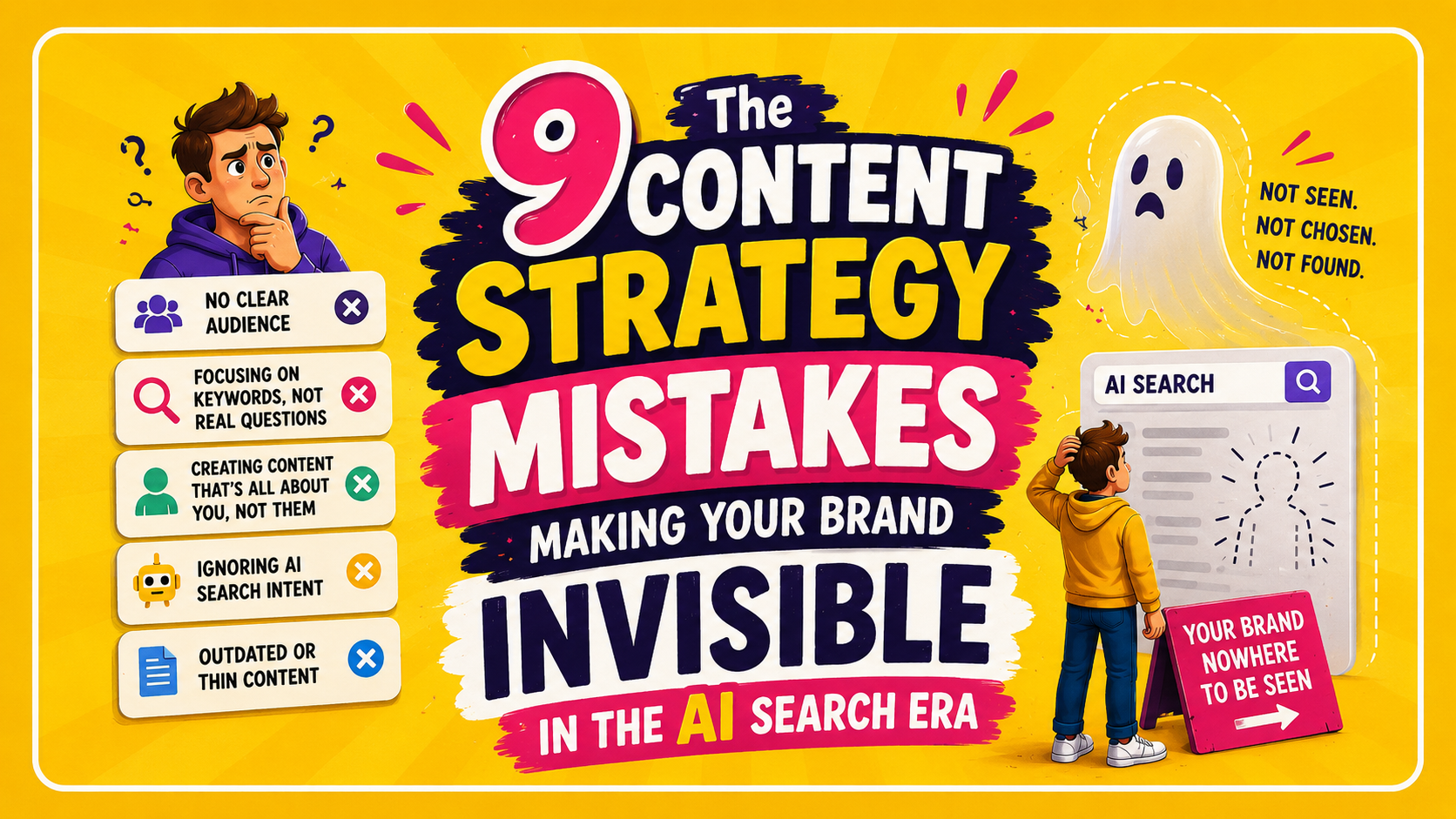
A few years ago, a buyer looking for a tool, agency, course, product, or service usually started in one predictable place.
Google.
They typed a keyword, scanned the first page, opened a few tabs, maybe read a comparison article, and eventually landed on a brand’s website.
That buyer journey still exists, but it is no longer the only journey. In 2025 and 2026, buyers are discovering brands through AI summaries, ChatGPT-style recommendations, Google AI Overviews, AI Mode, Reddit threads, YouTube reviews, TikTok search, creator content, newsletters, comparison pages, and community conversations.
The problem is that many brands are still writing content like it is 2018.
They are chasing keywords. They are publishing generic blogs. They are optimizing for rankings but not for trust. They are talking about themselves on their website while buyers are asking AI tools, Redditors, creators, and comparison sites who is actually worth paying attention to.
That shift is already visible in the data. McKinsey’s 2025 AI search research found that half of consumers use AI-powered search today, and it projects that $750 billion in consumer spend will flow through AI-powered search by 2028. The same research found that 44% of AI-powered search users say it is their primary and preferred source of insight, ahead of traditional search at 31%.
Google is moving in the same direction. In June 2025, Google introduced AI Mode in India as a Search Labs experiment, describing it as a way for users to ask longer, more complex, multimodal questions and continue with follow-up questions. Early AI Mode testers were asking queries two to three times longer than traditional searches.
So the issue is not whether AI search matters.
The issue is whether your brand is visible when buyers ask AI systems and communities who to trust.
Below are the nine content strategy mistakes making brands invisible in the AI search era, plus what to do instead.
I didn’t start with your website. I asked AI for a shortlist, checked Reddit for the real complaints, watched two YouTube demos, then searched your brand name.
BUYER QUOTE
1. You are still treating SEO like a ranking contest
The old SEO mindset was simple: rank higher, get more clicks, convert more visitors.
That logic is not dead, but it is incomplete.
Google’s 2026 guide to optimizing for generative AI features says SEO remains relevant because Google’s AI features are rooted in its core ranking and quality systems. The guide also explains that AI experiences use techniques such as retrieval-augmented generation and query fan-out to retrieve and synthesize relevant web pages.
That means your website still matters. Technical SEO still matters. Helpful content still matters. But ranking is no longer the whole game.
The new goal is to become retrievable, cite-worthy, and trusted.
A brand can rank and still be invisible in AI-generated answers. A competitor can appear in an AI summary because its content is clearer, more specific, better structured, more frequently cited by third parties, or more aligned with how buyers ask questions.
Semrush’s 2025 AI Overviews study analyzed more than 10 million keywords and found that AI Overviews grew from appearing on 6.49% of queries in January 2025 to 24.61% in July, then settled at 15.69% in November. The same study found that AI Overviews expanded beyond informational searches into commercial, transactional, and navigational intent.
That is a major shift for content teams. AI summaries are no longer only answering “what is” questions. They are moving closer to the buyer’s decision.
What to do instead
Stop measuring content success only by rank position. Add AI visibility metrics to your content dashboard:
- AI mentions
- AI citations
- Brand sentiment in AI answers
- Competitor mentions
- Visibility in comparison queries
- Mentions in Reddit and forums
- YouTube and TikTok search visibility
- Branded search growth
- Sales calls influenced by content
The future of SEO is not just “Can we rank?” It is “Can buyers and AI systems clearly understand, trust, and recommend us?”
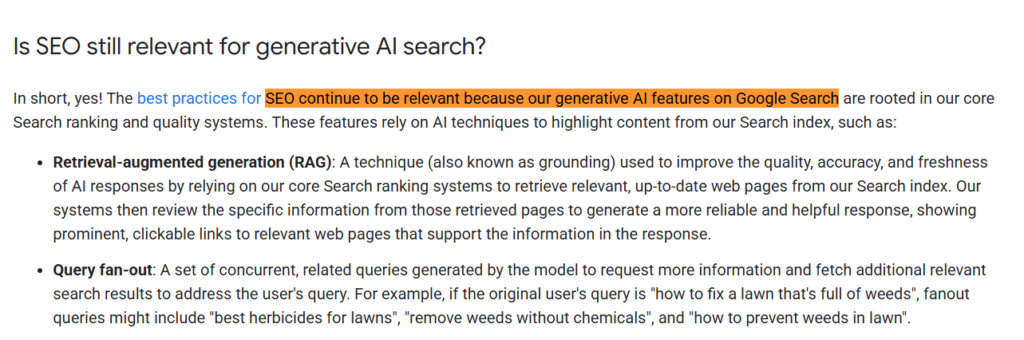
Source- Google
2. You are publishing generic content AI can summarize without you
Most brand blogs are not bad. They are worse than bad. They are forgettable.
They say the same things everyone else says:
“Create high-quality content.”
“Know your audience.”
“Use data to make decisions.”
“Build a strong online presence.”
True? Yes.
Useful? Barely.
Memorable? Not at all.
Google’s 2025 advice for succeeding in AI search says creators should focus on unique, valuable content for people, especially “non-commodity” content that is helpful and satisfying. Google’s 2026 guide goes further, saying brands should avoid simply recycling what others have already said or what could easily be produced by a generative AI model.
This is where many content strategies collapse. AI has raised the floor. Anyone can publish a polished 1,500-word article now. That means polish is no longer a differentiator.
Your content needs experience, evidence, and perspective.
It needs something AI cannot easily infer from the rest of the internet.
That could be original research, customer insights, founder lessons, teardown examples, mistakes from real campaigns, benchmarks, templates, internal frameworks, product data, or strong opinions based on lived experience.
What to do instead
Before publishing any blog, ask:
What do we know that competitors are not saying?
What have our customers taught us?
What data can we share?
What mistake can we help readers avoid?
What example proves the point?
What would make this page worth citing?
A strong AI-era article does not just explain a topic. It creates an evidence trail.
AI can summarize common knowledge. It cannot summarize your experience unless you publish it.
GOOGLE
3. You are ignoring Reddit and community validation
For years, brands treated Reddit like a risky place to avoid.
Buyers treat it like a truth filter.
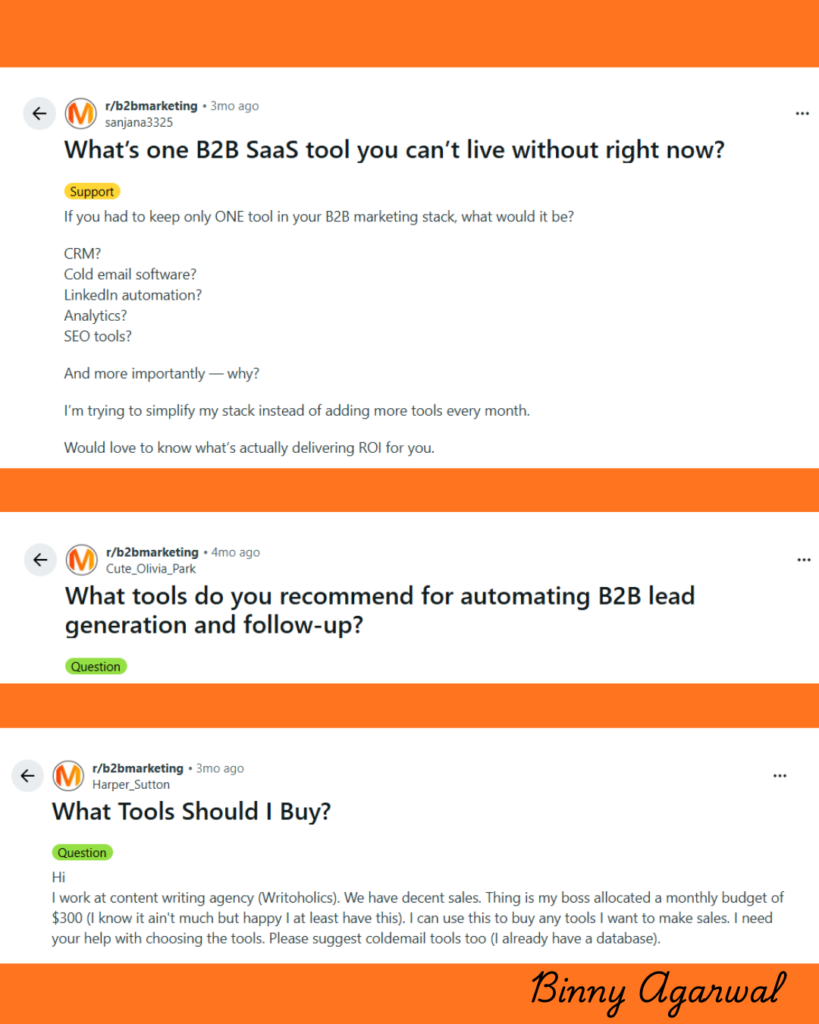
Reddit’s 2025 path-to-purchase research says 71% of people who discovered a brand online or offline researched it on Reddit. It also says 88% of users made a purchase based on information found on Reddit in the last year.
That matters because buyers do not only want your polished claims. They want real experiences.
They want to know:
Is this tool actually easy to use?
What breaks after onboarding?
Is customer support good?
Is the pricing fair?
What are the hidden downsides?
Which competitor is better for my exact situation?
Reddit is where polished marketing often gets challenged. A homepage might say “built for teams of every size.” A Reddit comment might say “great for enterprise, painful for startups.” Your landing page might say “simple setup.” A user might say “implementation took six weeks.”
That kind of conversation influences buyer trust. It also shapes the broader public web that AI systems can use to understand your brand.
Google’s 2026 generative AI optimization guidance notes that generative AI features can reflect what is said about products and services across blogs, videos, and forum discussions, while warning that inauthentic mentions are not helpful.
What to do instead
Do not spam Reddit. Do not create fake praise. Do not plant artificial conversations.
Use Reddit as a research lab.
Search for questions around your category, competitors, pricing, alternatives, use cases, frustrations, and decision criteria. Look for repeated language. Then turn those real questions into honest content.
For example:
“Is [category] worth it for small teams?”
“Best [tool type] for agencies?”
“[Competitor] alternatives for startups?”
“Why is [problem] so hard to solve?”
“What nobody tells you before buying [category]?”
Community-led content performs because it starts with what buyers already care about.
4. Your brand positioning is inconsistent across channels
AI search punishes messy positioning.
If your homepage says one thing, your LinkedIn page says another, your YouTube descriptions use old language, your founder bio says something different, your comparison pages focus on a different audience, and your directory listings are outdated, AI systems have to guess what your brand actually does.
That guess may not be flattering.
Semrush’s 2026 study found that only 22% of marketers say their SEO and AI search efforts are fully integrated across strategy, execution, and reporting. The same study found that 37% of marketers say competitors are mentioned more often than their brand in AI-generated answers, 30% say their brand is described inaccurately, and 29% say their positioning or value is unclear or generic.
This is not just a content issue. It is an operational issue.
Your brand is no longer defined only by your website. It is assembled from owned content, social profiles, third-party reviews, PR mentions, comparison pages, videos, Reddit discussions, podcast appearances, partner pages, and competitor content.
If those inputs are inconsistent, the output will be inconsistent.
What to do instead
Create a positioning nucleus for your brand.
It should include:
- One-sentence brand description
- Primary audience
- Core use cases
- Main differentiators
- Proof points
- Approved product language
- Competitor alternatives
- Preferred category language
- Messaging to avoid
Then update every major surface:
Homepage
About page
Product pages
Service pages
Schema
LinkedIn page
Founder bios
YouTube descriptions
TikTok bio
Podcast bios
Review site profiles
Directory listings
Partner pages
Sales decks
AI visibility starts with consistency.
If every channel explains your brand differently, AI will not clarify your positioning. It will average the confusion.
SEO EXPERT
5. You are writing for keywords instead of real buyer conversations
A keyword is often too small to capture modern search behavior.
A traditional keyword might be:
“best CRM software”
A real AI-era query sounds more like:
“What is the best CRM for a 12-person B2B SaaS team that needs HubSpot integration, low admin work, and simple reporting?”
That is not just a longer keyword. It is a different kind of intent.
Google’s AI Mode is built for complex and nuanced questions, including comparisons, how-to tasks, and follow-up questions. Google says AI Mode uses query fan-out, breaking a question into subtopics and issuing multiple related queries to find more relevant content.
This means your content cannot only match keywords. It has to satisfy decision paths.
A buyer does not move neatly from awareness to consideration to conversion. They jump around. They ask AI for a shortlist. They check a Reddit thread. They watch a creator review. They compare pricing. They search “[brand] problems.” They ask a friend. They come back three days later.
Your content needs to follow that reality.
What to do instead
Build prompt-path clusters instead of keyword-only clusters.
For one topic, map the questions buyers ask across the whole decision:
What is this?
Why does it matter now?
Who is it for?
Who is it not for?
What are the alternatives?
How much does it cost?
What mistakes should I avoid?
How do I compare vendors?
What does implementation look like?
What should I ask before buying?
Then create content in multiple formats:
- Blog posts
- Comparison pages
- FAQs
- Video explainers
- Short-form clips
- Templates
- Checklists
- Customer stories
- Expert interviews
- Community responses
The best content strategy does not chase isolated keywords. It answers the conversation around the purchase.
6. You avoid comparison content because it feels uncomfortable
Many companies hate writing comparison content.
They do not want to name competitors. They do not want to admit trade-offs. They do not want to say who their product is not for.
But buyers are comparing you anyway.
AI systems are comparing you too.
A 2026 paper on Product Hunt startups tested 112 startups from the 2025 Product Hunt leaderboard across 2,240 LLM queries. It found that models recognized products by name at very high rates, but discovery-style questions such as “best AI tools launched this year” produced much lower success rates, 3.32% for ChatGPT and 8.29% for Perplexity.
That is the discovery gap.
Being known by name is not the same as being recommended by need.
If your brand does not publish comparison content, AI systems and buyers will rely on other sources: affiliates, competitors, outdated listicles, Reddit comments, review sites, and creator opinions.
Some of those sources will be fair. Some will not.
What to do instead
Create honest comparison content.
Publish pages like:
Best [category] tools for [audience]
[Your brand] vs [competitor]
Top [competitor] alternatives
How to choose a [category] platform
Best [category] software for agencies
Best [category] software for startups
Who should not use [your product]
Be specific. Include pricing context where possible. Explain strengths and weaknesses. Show decision criteria. Admit where a competitor may be a better fit.
This does not weaken your brand. It builds trust.
The brands that win comparison searches are not always the ones that claim to be best. They are the ones that help buyers decide.
7. You treat video as a campaign asset, not a search asset
Video is not just for awareness anymore.
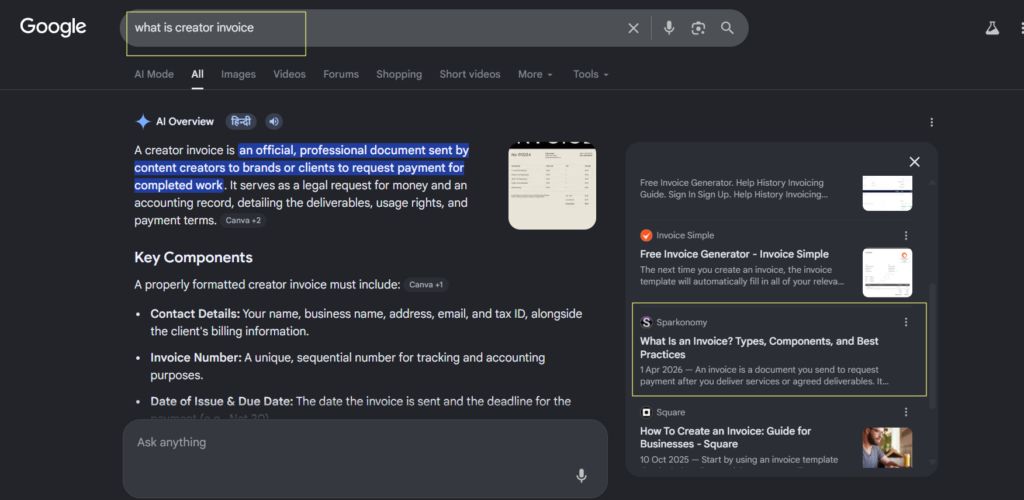
It is a search. It is proof. It is trust. It is a comparison. It is product education. It is buyer enablement.
Google India’s 2025 Marketing Live article says 80% of Gen Z relies on Google Search for shopping, discovery, research, and decisions, based on GWI data from February 2025. The same article frames the modern consumer journey as a complex web of interactions across Search, YouTube, feeds, entertainment, and shopping.
TikTok is also becoming a search environment. TikTok’s 2025 Search Ads Campaign article says its community conducts billions of searches every day, with total searches up 40% year over year. It also cites WARC research saying 86% of Gen Z internet users search on TikTok weekly.
That means your blog cannot carry the full weight of discovery.
A buyer may not want a 2,000-word explanation first. They may want a 45-second proof clip, a screen recording, a founder explanation, a teardown, a tutorial, or a creator review.
What to do instead
Turn every major blog topic into a video search asset.
For this blog, for example, the video versions could be:
“9 reasons your brand is invisible in AI search”
“Why your SEO strategy still feels stuck in 2018”
“How buyers really discover brands in 2026”
“Reddit, TikTok, YouTube, and AI: the new content funnel”
“Stop writing generic blogs. Start building proof.”
Optimize the video title, description, captions, spoken keywords, chapters, thumbnail, and on-page embed.
Use YouTube for depth. Use TikTok for fast discovery. Use LinkedIn for professional interpretation. Use your blog as the canonical resource that ties the ideas together.
Video should not sit outside your SEO strategy. It should be part of your search strategy.
People do not only want answers. They want to see how something works before they trust it.
sEMRUSH
8. You are measuring traffic while influence moves elsewhere
The old dashboard was built for a click-first world.
Sessions. Rankings. Click-through rate. Conversions. Assisted conversions. Backlinks.
Those metrics still matter, but they do not capture the full AI-era journey.
A buyer may see your brand in an AI answer, validate you on Reddit, watch a YouTube comparison, search your name, and convert through a direct visit. Your analytics may credit direct traffic, even though content shaped the entire decision.
Semrush’s 2026 study found that measurement is one of the biggest gaps in AI search operations. It reported that 49% of marketers struggle to measure AI’s impact on pipeline or revenue, 45% struggle to measure visibility in AI-generated answers, and 40% use manual ChatGPT checks as their main tracking method.
A 2026 academic study comparing Google Search, AI Overviews, and Gemini across 11,500 real-user queries found that AI Overviews were generated for 51.5% of representative queries and displayed above organic results. The study also found that retrieved sources differed substantially across traditional Google Search, AI Overviews, and Gemini.
Translation: visibility is becoming more fragmented.
You may be visible in classic search but absent in AI summaries. You may be mentioned in Reddit but missing from comparison pages. You may rank for a blog post but lose the shortlist conversation.
What to do instead
Build a modern content visibility scorecard.
Track:
AI answer mentions
AI citations
Brand sentiment in AI responses
Competitor share of voice
Branded search growth
Reddit mentions
Forum mentions
YouTube search rankings
TikTok search visibility
Comparison page performance
Review-site positioning
Referral quality from communities
Sales calls mentioning content
Direct traffic after major content pushes
The question is no longer “How much traffic did this blog get?”
The better question is “Did this content make us more likely to be trusted, cited, compared, and shortlisted?”
9. You are chasing AI hacks instead of building authority
Every new search era creates shortcuts.
In the AI search era, the shortcuts sound like this:
“Create an llms.txt file.”
“Rewrite everything for AI.”
“Chunk all your content.”
“Add more FAQ blocks.”
“Mention your brand everywhere.”
“Mass-produce pages for every possible prompt.”
Google’s 2026 guidance is clear that many of these supposed AI search hacks are unnecessary for Google Search. It says brands do not need special AI text files, do not need to chunk content in a specific way, do not need special schema for generative AI search, and do not need to rewrite content only for AI systems. It also warns against pursuing inauthentic mentions.
This is important because brands are already being sold in panic.
Product Hunt’s GEO Tools category, last updated on June 9, 2026, listed 48 products and 156 reviews, defining GEO tools as products that help marketers optimize content for discovery in AI-powered search and generative engines.
Tools can help. They can monitor mentions, compare visibility, detect gaps, and support workflows.
But tools cannot replace authority.
A 2026 research paper on citation behavior in AI answer engines found that topical relevance and list position were the biggest drivers of being cited first. It also found that explicit price information and recent timestamps helped consistently, while completeness and trust cues added smaller gains.
That points to a simple truth: AI visibility depends on useful, relevant, current, trustworthy content.
Not hacks.
What to do instead
Build an authority flywheel:
- Clear positioning creates understanding.
- Useful content creates trust.
- Original proof creates citations.
- Community presence creates validation.
- Third-party mentions create authority.
- Consistent messaging creates retrievability.
- Retrievability creates AI visibility.
This is where off-page SEO becomes more important, not less.
Use ethical digital PR, original data, expert quotes, podcast appearances, guest insights, link reclamation, broken link building, review management, community participation, and local citations where relevant.
Avoid private blog networks, fake reviews, link schemes, fake Reddit mentions, and manipulative anchor text. Healthy off-page SEO should reinforce trust, not manufacture it.
The new rule: AI search rewards proof
AI search is not killing content strategy. It is exposing weak content strategy.
Brands become invisible when their content is generic, inconsistent, hard to compare, and disconnected from where buyers actually search, including AI tools, Reddit, YouTube, TikTok, and Google.
The fix is not more content. It is stronger evidence.
Your brand needs clear positioning, useful insights, credible proof, consistent messaging, and content that buyers can trust across every discovery channel.
In 2026, the brands that win will not be the loudest. They will be the easiest to understand, cite, compare, and recommend.
Need help with this? I am Binny Agarwal, I help brands improve AI visibility through content strategy, search-led positioning, and proof-driven content built for how buyers discover and trust brands today.
No responses yet